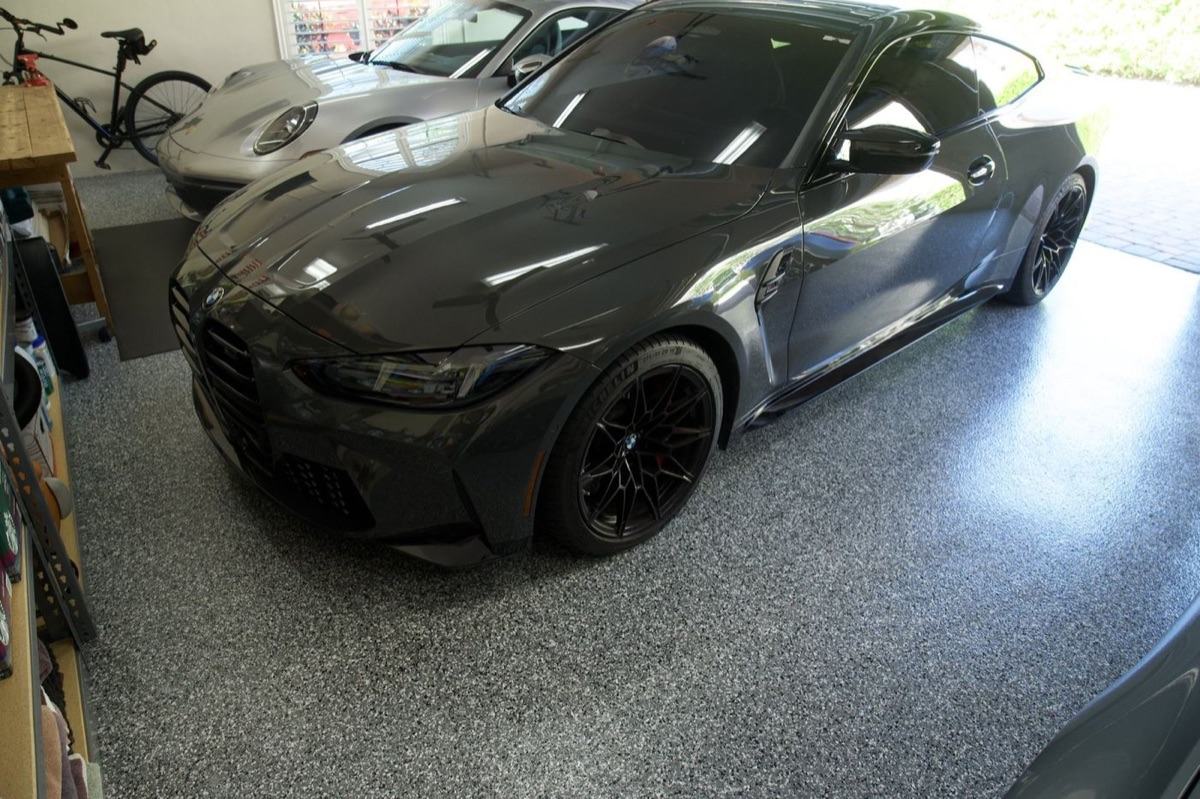
Polyaspartic garage floor coating for Tampa homes
Polyaspartic garage floor coating is a fast-curing coating that stays clear in sunlight, and many Tampa garages now get it as the topcoat or the whole floor. Here is how it compares with epoxy in a humid climate, and what decides which one your slab gets.
- Local Tampa-area installers
- Free written quote
- Slab checked for moisture first
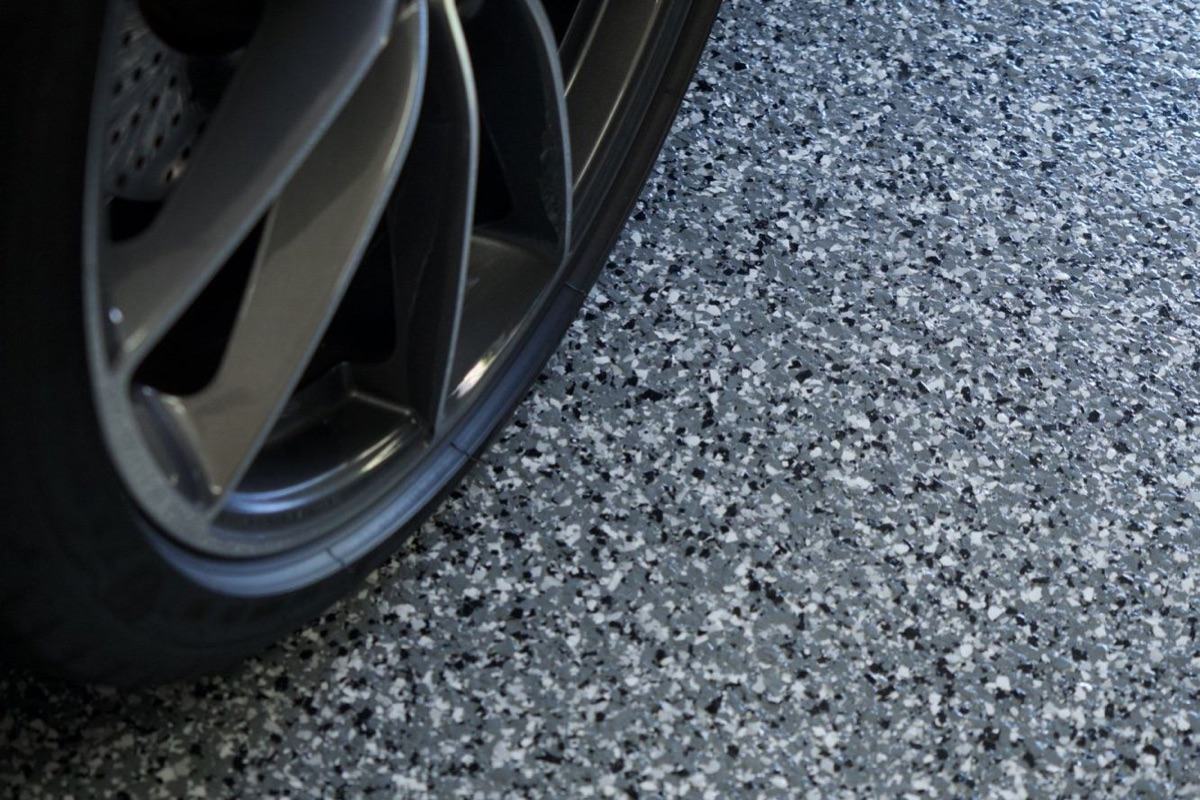
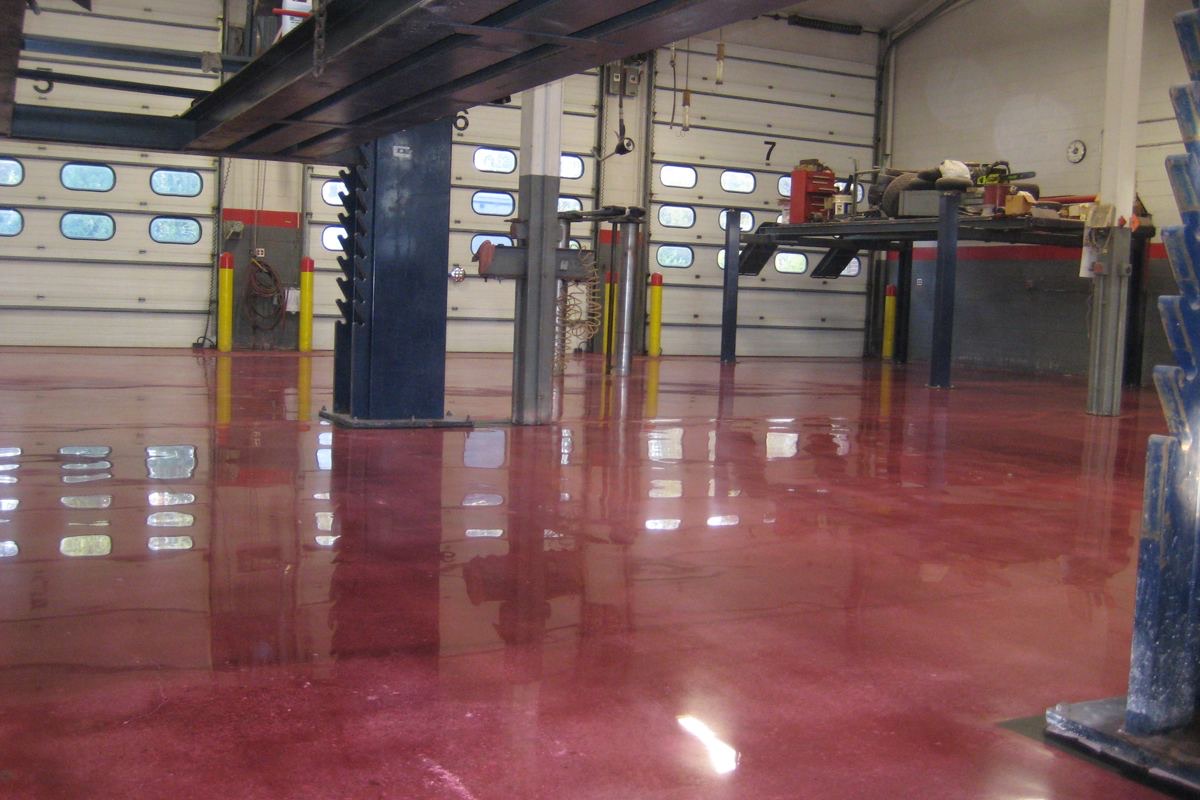
Example photos of finished floors, shown for the look. Not photos of a specific past job.
What is the difference between polyaspartic and epoxy on a garage floor?
Epoxy cures slowly, bonds deeply and builds thickness; polyaspartic cures much faster, stays clear in sunlight and is often used as the top layer over an epoxy or polyurea base.
Both are two-part coatings that harden by chemical reaction, and both can carry flake or color. The difference is in how they cure and how they age. Epoxy gives the installer a long working time, soaks into ground concrete and builds a thick, hard layer, but it ambers and chalks where sunlight reaches it. Polyaspartic belongs to the polyurea family: it cures far faster, handles a wider range of temperatures and does not yellow, but its short working time leaves little room for error.
That is why many Florida garage floors are built as a system: a base coat chosen for bond, flake broadcast into it, and a polyaspartic topcoat chosen for sun and wear. Some garages get polyaspartic all the way through.
Epoxy
Long working time, strong bond, builds thickness. Ambers and chalks in direct sun, so in a garage that opens to daylight it is usually kept under a UV-stable topcoat.
Polyaspartic
Fast cure, UV-stable, works across a wide temperature range. It sets quickly, so it needs a crew that has done it before.
Combined systems
A base coat for bond, flake for texture and a polyaspartic top for sun and wear. A common build for Florida garages.
Why do garage floors fail in Tampa's humidity?
Most failures come from moisture moving up through the slab or from thin surface prep, not from the coating itself.
Garage slabs here sit on the ground, often over a high water table, and older homes may have no working vapor barrier under the concrete. Moisture moves up through the slab toward the dry side, and a coating that seals the top traps it. The result is blisters, white haze and coating that peels in sheets, usually starting near the door or on the low side of the floor.
Summer adds its own problems: humid air changes how coatings cure on the day, and a hot tire straight off the road can pull up a coating that never bonded properly. None of that is fixed by choosing a fancier topcoat. It is fixed by testing the slab and preparing it properly before anything goes down.
Moisture vapor
The slab is tested before a system is chosen. Where it reads high, a moisture-tolerant primer goes down first.
Hot tire pickup
Hot tires soften weakly bonded coatings and lift them. Grinding the surface and building the system right is what prevents it.
Sun at the door
Afternoon sun through an open garage door yellows plain epoxy along the door line. A UV-stable topcoat keeps the color even.
Humid install days
Epoxy curing in damp air can develop a greasy film called blush, while polyaspartic speeds up in heat. Timing and product choice follow the weather.
What does a polyaspartic garage floor cost in Tampa?
It is priced after someone sees the slab; polyaspartic materials cost more than standard epoxy, but the condition of the concrete usually moves the price more than the coating does.
A sound slab in a newer home is mostly prep and coating. An older slab with an old paint job, cracks and high moisture readings is a bigger job before the first coat goes down. You get a written price before anything is booked.
Size
One, two or three car bays, plus any storage room or golf cart bay that is included.
Slab condition and moisture
Cracks, pitting, spalled joints and whether a moisture-tolerant primer is needed.
Old coatings
Paint or a failed epoxy has to be ground off before anything new goes down.
The system
Full polyaspartic, or a base coat with a polyaspartic top, and how much flake goes in.
The finishes, under the lights
Keep scrolling to walk the floor. Your installer brings physical samples to the quote.
How does a polyaspartic garage floor go in?
Free visit and written quote
Someone looks at the slab, measures the garage and shows you physical samples of the flake blends and colors. You get a written price before anything is booked.
Moisture test
The slab is tested before a system is chosen. Where it reads high, a moisture-tolerant primer goes down first.
Diamond grinding
The surface is diamond-ground with a vacuum attached to keep dust down, so the coating bonds into the concrete instead of sitting on top.
Crack and joint repair
Cracks, pits and damaged joints are filled and ground flush.
Base coat and flake
The base coat goes down and flake is broadcast into it, edge to edge.
Polyaspartic topcoat and walkthrough
The clear polyaspartic topcoat seals the flake and takes the wear. You walk the floor with the installer and get care instructions and a clear time for foot traffic and cars.
Floors that stop people at the door
How a floor gets done
Three stages, and you know the price before any of them start.
What moves the price
Two garages the same size can quote differently. These are the reasons.
Questions people ask before booking
Questions about polyaspartic garage floors
How much does a polyaspartic garage floor cost in Tampa?
It depends on the garage. The number of bays, the condition of the slab, any old paint or epoxy that has to be ground off and the system you choose all move the price. Polyaspartic materials cost more than standard epoxy, but prep usually matters more. Someone looks at the floor first, and the written quote is free.
How soon can I park on a polyaspartic floor?
Sooner than on a standard epoxy floor, because polyaspartic cures faster. The exact time depends on the system, the temperature and the humidity on the day, and light foot traffic comes well before a car does. The crew gives you a clear time before they leave, so you are not guessing when it is safe.
Is polyaspartic better than epoxy for a Florida garage?
For the top layer of a garage that opens to the sun, it usually is, because it does not yellow. Epoxy still earns its place as a base coat, with a long working time and a deep bond. Whichever goes on top, slab moisture and surface prep decide how long the floor lasts.
Will polyaspartic turn yellow in the sun?
Polyaspartic topcoats are UV-stable, so they hold their color in sunlight far better than epoxy, which ambers over time wherever the sun reaches it. In a Tampa garage that sits open in the afternoon, that difference shows first along the door line, which is why the topcoat is usually polyaspartic.
Do I need to empty the garage?
Yes. The floor has to be completely clear for grinding and coating, so plan somewhere for the cars, bikes, tools and shelving for the length of the job and the cure. Wall cabinets can usually stay where they are. Ask what needs to move when you get the quote, so the first morning starts on time.
Related pages
Bayshore Epoxy Floors works across Hillsborough County. Back to the main site.